Ok, pretty much all of Turin’s life journey is dark, particularly the time when he is under the curse, but I’m specifically referring to the time from the slaying of Beleg when Gwindor (Flinding) leads him in a stupor to the Pools of Ivrin where he was healed of his madness by the waters.
“But courage and strength were renewed in the Elf of Nargothrond, and departing from Taur-nu-Fuin he led Turin far away. Never once as they wandered together on long and grievous paths did Turin speak, and he walked as one without wish or purpose, while the year waned and winter drew on over the northern lands. But Gwindor was ever beside him to guard him and guide him; and thus they passed westward over Sirion and came at length to the Beautiful Mere and Eithel Ivrin the springs whence Narog rose beneath the Mountains of Shadow.” The Children of Hurin, The Death of Beleg pgs. 156 – 157.
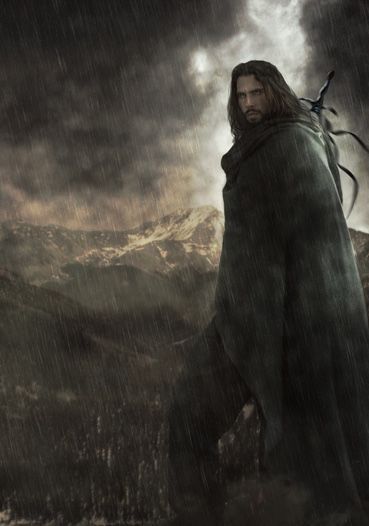
Artist Unknown
This is all that is said of the journey from the Taur-nu-Fuin to Eithel Ivrin.
The Mountains of Shadow are the Ered Wethrin, the mountain range marking the southern border of Dor-lomin and Mithrim. The Narog begins at Eithel Ivrin where Nevrast and Dor-lomin meet.
According to Fonstad’s Atlas of Middle-earth, the Orc camp to the Fen of Serech is about 100 miles and from there to Ivrin is another 130 miles.
Now consider what was written of this same journey in the Lays of Beleriand:
“Thus reached they the roots and the ruinous feet
Of those hoary hills that Hithlum girdle,
The shaggy pinewoods of the Shadowy Mountains.
There the twain enfolded phantom twilight
And dim mazes dark, unholy,
In Nan Dungorthin where nameless gods
Have shrouded shrines in shadows secret,
More old than Morgoth or the ancient lords
The golden Gods of the guarded West.
But the ghostly dwellers of that grey valley
Hindered nor hurt them, and they held their course
With creeping flesh and quaking limb.
Yet laughter at whiles with lingering echo,
As distant mockery of demon voices
There harsh and hollow in the hushed twilight
Flinding fancied, fell, unwholesome
As that leering laughter lost and dreadful
That rang in the rocks in the ruthless hour
Of Beleg’s slaughter. “Tis Bauglir’s voice
That dogs us darkly with deadly scorn’
He shuddering thought; but the shreds of fear
And black foreboding were banished utterly
When they climb the cliffs and crumbling rocks
That walled that vale of watchful evil,
And southward saw the slopes of Hithlum
More warm and friendly. That way they fared
During the daylight o’er dale and ghyll,
O’er mountain pasture, moor and boulder,
Over fell and fall of flashing waters
That slipped down to Sirion, to swell his tide
In his eastward basin onward sweeping
To the South, to the sea, to his sandy delta.”
(The Lays of Beleriand, lines 1472 – 1503)
The next stanza indicates after seven journeys they arrived at Ivrin’s lake.
Reading this passage more closely in addition to the distance, there is an eerie darkness of a potentially greater evil than Morgoth:
“In Nan Dungorthin where nameless gods
Have shrouded shrines in shadows secret,
More old than Morgoth or the ancient lords
The golden Gods of the guarded West.”
Morgoth we know, and the golden Gods of the guarded West are the Valar, but what of the nameless gods who have shrines, something very rare in the stories of Middle-earth.
And what about Nan Dungorthin?
The Index of Middle-earth indicates that Nan Dungorthin appears in volumes III and IV. An earlier form is Nan Dumgorthin and a later form is Dungortheb. It also says to see Nan Orwen, which appears in volume III (p. 148) as a transient substitution for Dungorthin.
Nan Dumgorthin is ‘the Land of the Dark Idols’, volume II (pgs. 35, 62, 68).
Nan Dungortheb is ‘the Valley of Dreadful Death’, volumes I, II, X, and XI.
Looks like this will be a future post.
This part of the journey is reminiscent of Aragorn’s journey to the Oathbreakers, or Dead Men of Dunharrow in the Third Age.
“But the ghostly dwellers of that grey valley
Hindered nor hurt them, and they held their course
With creeping flesh and quaking limb.”
After this Flinding believes it to be Morgoth himself taunting them:
“As that leering laughter lost and dreadful
That rang in the rocks in the ruthless hour
Of Beleg’s slaughter. “Tis Bauglir’s voice
That dogs us darkly with deadly scorn’”
The darkness ends as they emerge from this region and see to the south the slopes of Hithlum they continued to journey in daylight now and waters they passed flowed into the Sirion and from there to the sea.
This would conflict with the Atlas in that Dor-lomin is north of the rivers Sirion and Narog and it is the southernmost region of Hithlum. It would be more correct seeing to the south the slopes of West Beleriand or more specifically Dor-Cuarthol which was more of a sloped grassland compared to Brethil to its east which was a forest. The Narog bordered Dor-Cuarthol on the West and the Sirion was the eastern border of Brethil. All of the rivers then flowed into the Sirion before reaching the sea in this region.
The Lays version of the Children of Hurin is one of the Professor’s earliest works and sadly unfinished. As evidenced from this dark journey, he could write chilling descriptions of physically, mentally and spiritually arduous journeys.
Incorporating this journey, along with the one in which he travels as a child from Dor-lomin to Doriath would have greatly enhanced the telling of the story and presented the reader with a deeper understanding of the anguish and near death experiences Turin encountered.
 Ross Raymond Nunamaker