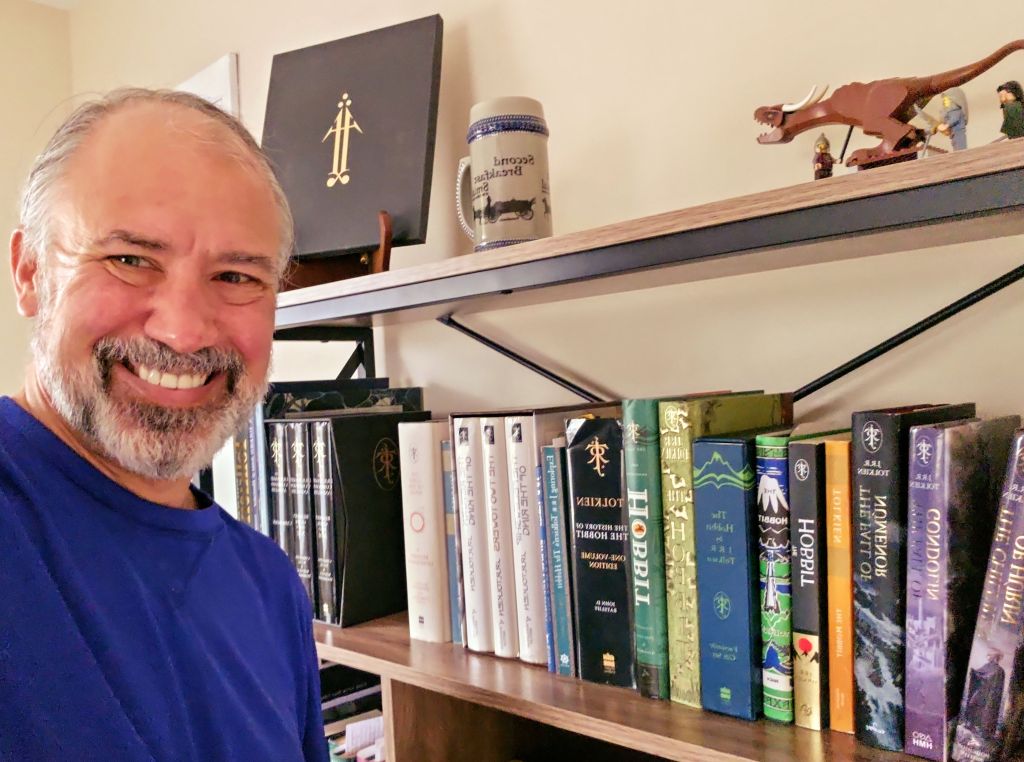
The Tolkien Society is offering something new for members this year, the Big Read, which is effectively an every other week book club featuring a topical presentation of the week’s read.
Conducted via Zoom there are two sessions, one for each side of the pond. There is a presenter who offers information on the reading, its history, scholarship and opinion, and then there are discussion break outs.
As it was the first, I’m not sure how the break outs were determined, but everyone was assigned a room, mine had six people with a volunteer host as one of those to facilitate if needed.
The topic was Tolkien’s lecture and essays of Fairy-stories and its focus on the function of recovery, escape and consolation, though it mostly addressed the first two. It was presented by Erik Andersson.
I enjoyed the presentation and breakout discussion.
The session itself had me thinking of the duality of escapism related to fantasy. People often refer to fantasy as escapist and mean it to be a dirty word.
The point was made from the essay that no one would argue with a war prisoner’s desire to escape, but they would with a deserter’s wish to flee.
Fairy is clarified as having several components and the physical realm where these fantastical beings inhabit is one. Tolkien referred to it as the perilous realm. It is not a world of comfort.
Fairy is built from our reality. Speech exists and animals exist and in fairy they are joined, unlike our world. Fairy is fantasy grounded in our reality.
Fairy requires recovery. This may not mean what you think. To recover is to see again as if it were new. It is the means by which we bypass the obstacles and obstructions of the modern world. We find clarity through fantasy, which removes these barriers and by recovering in fantasy we take our perspective and insight with us back to reality.
It was commented that much of fairy is folk in its setting. It is green and forested or agrarian, not industrial. It is more medieval than modern.
I attempted to express how I’ve come to read Tolkien’s works with a particular focus on the journey, place and recovery since I first read On Fairy-Stories. And I’ll try again here.
Reality, where we are in place and time now in real life, I view as comfort. The comfort of the Shire is the hobbits’ reality. They do not live in a fantastical world, they live in comfort, as we do, in their real life. Fantasy is encountered by the hobbits when they leave the Shire and enter the perilous realm, or when they’ve unwittingly become enmeshed in the perilous realm and it comes to them or draws them to it.
They are not transformed instantly into it. They journey from comfort to peril. They are granted safe harbors along the way, such as protection by the elves in the Shire, at their home in Crickhollow among the Bucklanders, in the house of Tom Bombadil, and eventually in the last homely house of the west, Rivendel.
There and back again. The return to the Shire after having been through the perilous realm gives them a view of the Shire, their reality, and themselves, through the lens of recovery. They see it as if for the first time compared to the perilous realm and given that they appreciate it. They also see themselves or have it pointed out to them as Gandalf did to Bilbo, that they have changed as a result of it.
For me the physical realm, the journey between the comfort of reality and the peril of fantasy, and the character’s response to it, or recovery is what makes a story one of fairy.
The next Big Read is on the first seven chapters of the Hobbit, where we’ll see this begin to play out as Bilbo debates comfort versus peril and succumbs to the pull of peril.
 Ross Raymond Nunamaker
Leave a comment