I’ve always enjoyed writing, well loved it. Since I started finally taking it more seriously, I decided to share what I’m learning. This page is being edited as I develop my understanding and approach with the goal of keeping myself aligned and helping others define what writing is for them.
Quality writing is objective. Universally, though it is dependent on the creativity and quality of the thinking that goes into it in equal measure with one’s mastery of the craft of writing itself.
One’s lived experience and intimate knowledge of other’s lived experience, benefits the writer who can convey events and their affiliated emotions through the nuanced details that arrive from knowing in right ordered and well-chosen words.
Honesty requires exposing one’s self emotionally and delivers authenticity. Everyone has a lived experience. Being able to express the experience with a balance of raw and restrained emotion and feeling is the responsibility of the writer. Without this, the writing tends to lack a core connection with the reader – the writing will feel soulless.
Restraint arrives when the writer learns to trust the reader. Being honest and exposing yourself should be enough for the reader to decide what meaning there is in your story.
If you have done your job well, the reader will understand your intention and you will not have to tell them what it is. This is writing with restraint.
Experience and thinking won’t make you or me a good writer. It should lead to considering what is actually known and unknown about any given subject. From that I try to learn more about what I don’t know and progress from knowing how to write to being a writer to being a ‘good’ writer.
Outside of my professional work, I have mostly written blog posts and essays. At the end of 2025 I embarked on fiction writing. I wasn’t sure what I’d write about or in what format, but I started thinking of scenarios and characters. Many were rooted in my own experiences – write what you know. It was a start.
In four months, I became invested in writing. I joined a local established writer’s group and a brand new one at my local library. I completed a 60,000 word first draft of a novel. It is a contemporary retelling of Joseph Conrad’s The Secret Agent. Ten months later I’m on my fourth version and umpteenth draft. Learning requires rewriting.
While excited about my progress, I learned I knew very little. I didn’t know what my story was going to become. I knew it was prose, not poetry. It was a novel, but what genre?
I knew what I read, what I liked, and what I didn’t, but couldn’t say what genre any of them were. What was the plot type? I hadn’t given it any thought. What was the plot? Which character’s story was it? This simple question, which ought to be the most straight forward, became the most challenging.
In Conrad’s story Adolf Verloc was the Secret Agent. In my retelling, as I wrote, I wanted it to be Winnie, so I retitled it, the Grit Girl. Somewhere during version three, I began to flirt with Kate, the cyber-agent who was not an original character. She was born of the story and slowly the flirting became an affair. By version four she became the main character.
It turned out I didn’t know as much about my book as I first thought – this despite copying it from Conrad! I had a blueprint and still didn’t get it.
After two revisions of my novel, I took a writer friend’s advice to try short story writing. What I wrote, I came to realize was creative non-fiction. In March and April I wrote six short pieces, which helped me focus on character, point of view, and editing my own writing.
It helped me better understand what I enjoyed writing about and how I liked to write.
Now, I’ve come to realize that my creative nonfiction is stronger than my fiction, my novel needs work, but has potential, and my nonfiction project has real possibility.
I also realize, they all still need work. With learning comes the understanding that there is more work to do – a better way to represent the thoughts you are trying to put down on paper.
My Writing Style
I like to write about things I am curious about and often these are related to the tensions and contradictions that drive human behavior. I like to get inside the head of characters and use setting as a character to help tell the story. I want my characters to be observant, vulnerable, and engage in natural dialogue and actions while maintaining emotional restraint in a trying, absurd, world.
I try to be clear, direct, and honest, which is harder than I thought, because to be honest one must expose oneself emotionally and we are essentially taught not to do that growing up. I strive to write with intention and rhythm. I want to be psychologically attuned to be consistent, calm, thoughtful, and grounded.
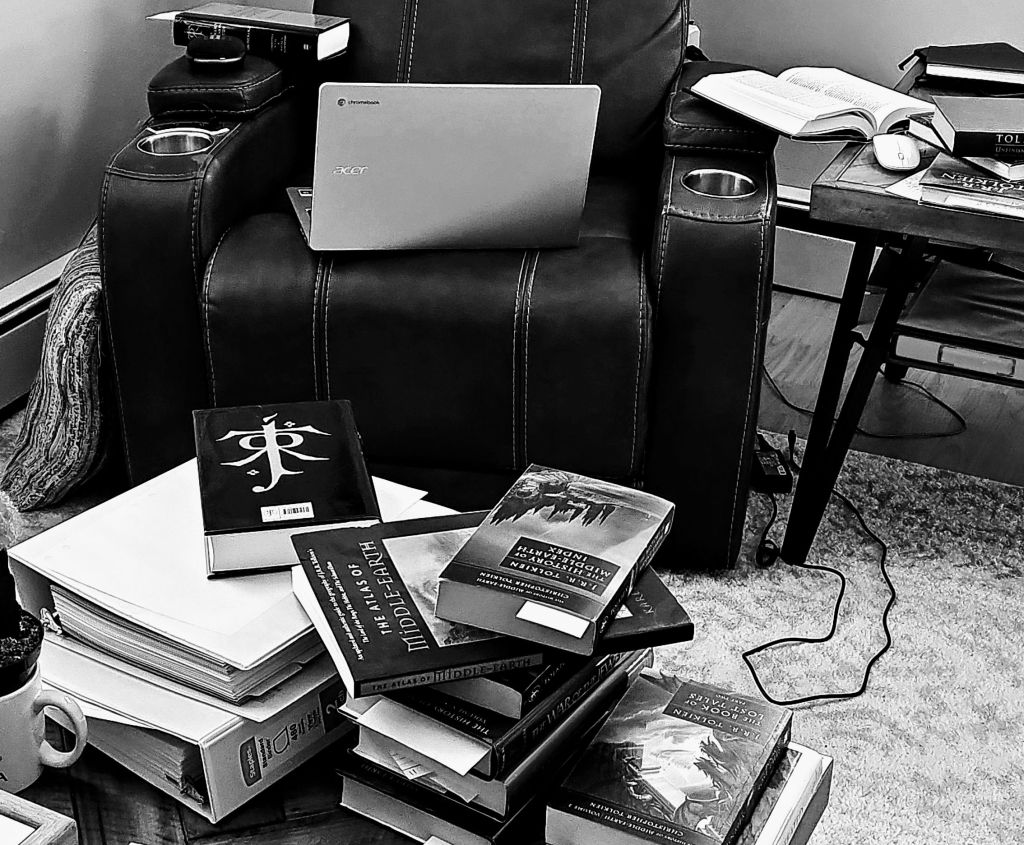
Tolkien has taught me that there is a right word for every situation. Being a philologist Tolkien took this to another level. His word choice was not only in current meaning, but in the word’s origin which added depth to his writing.
My own word choice is not as well done as his. I prefer clean, contemporary, and emotionally precise words. I try not to be repetitive, to remove what is not necessary, and reveal what is needed for the reader to understand the character, scene or story.
I want my word choice to feel transparent in the sense that the reader believes anyone can write this until they try and recognize it is not the case. I want my writing to read as effortless and elegant, not jarring or loud. A good jolt at the right time, however, is gold.
Closing Thoughts
In my current writer’s bio I describe myself this way:
Ross R. Nunamaker leverages lived experience, place as character, and hope amidst chaos, while maintaining emotional restraint as he explores the disconnect between reality and desire.
One of the things I value personally is a love of learning and my primary engagement of it is through scholarship: reading, writing, research, thinking creatively, and presenting.
When I say I’m a writer, it is in the sense that I value and enjoy writing. It is personal. The process of writing allows me to engage in scholarship and express my thoughts and ideas. These things are important to who I am as a person. It is a part of my being.
I’d like to one day be published by a literary journal or a traditional, print publisher, but I won’t be defined by it. Being a published author would be great. The process would validate the work being published.
However, it would be an additive external accomplishment separate from how writing daily enables me to derive joy by doing what I value, and that is why I consider myself a writer.
More…
Orientation: Return home, or see what I’m currently doing, what I’ve done, and where I might be going.
Southwest (meaning/journey): The Resilient Seeker.
West (meaning): The Compass & the Current.
North (self): My Evolving Words to Live By.
South (journey): The Nunamaker Group.

