I didn’t think I would be interested in short fiction and I had never heard of Creative Non-Fiction, Fiction Adjacent, or Autofiction prior to 2026, when I re-engaged in writing after a long history of an off and on love-hate relationship with fiction writing.
This time around I began writing and immediately sought counseling in the form of a writer’s group, which was well organized and offered not only weekly events, but an annual conference exposing me to a range of people and writing styles I was unaware of previously.
Beginning with the most humble of intentions, write a generational novel of significance, the next great, American classic, I found I didn’t know as much as I thought, but wasn’t half bad at what I was trying to do.
I needed to hone my skills.
Write tight. Show don’t tell.
A writing group friend who was immediately supportive of my effort suggested short fiction. Inside I scoffed. Then I sniffed, moved the food around on my plate cautiously, took a bite, and what do you know, I liked it.
In April through mid-May, as I wrote this, I finished eleven pieces across fiction and creative non-fiction. They ranged from 5,730 to 161 words in length.
The shortest is my latest, and potentially my ‘best’, though best is clearly hard to define.
I say best, because with 161 words, every single word has at least one function and often multiple roles to play for the story to work.
The longer the piece, the easier it is to keep strays, asides, and wander. The start and ending is strong, it could be stronger when the story is longer by compressing them. The middle drags, it has time, or does it?
My short stories 2,500 to 6,000 words aren’t bad, but they aren’t as strong as my under 1,000 word stories.
The first draft of one story landed around 1500 words and when I was done it was under 700 and told a story spanning four generations addressing recovery and renewal through the act of giving.
To better understand the craft of writing short stories, I decided to start reading stories from those deemed to be the standard for short story writing. I started with Chekhov and Mansfield, which led me to Hemingway.
“For sale: baby shoes, never worn.” Flash fiction in its finest form, maybe. Actually written by Hemingway, probably not, but still, good writing.
There is a mini industry around six word stories and flash fiction is popular and hard, while being fun.
What was my 161 word story about? A person acknowledging that being alone in life without a spouse or significant other, is more than okay, it is good.
It started in three places. The first I’d already written. It was a story about me coming to terms with being alone and no longer dating after a year of trying following a two year break from a divorce after over twenty-five years of marriage.
The second was on the trail when I stopped in a clearing to record birds on a birding app. The app used GPS to determine location and matched the sounds to a database of birds. As matches were made a picture of the bird and its name was displayed. I record for up to a minute and save. Later you can revisit the date, click on the bird and get info on it.
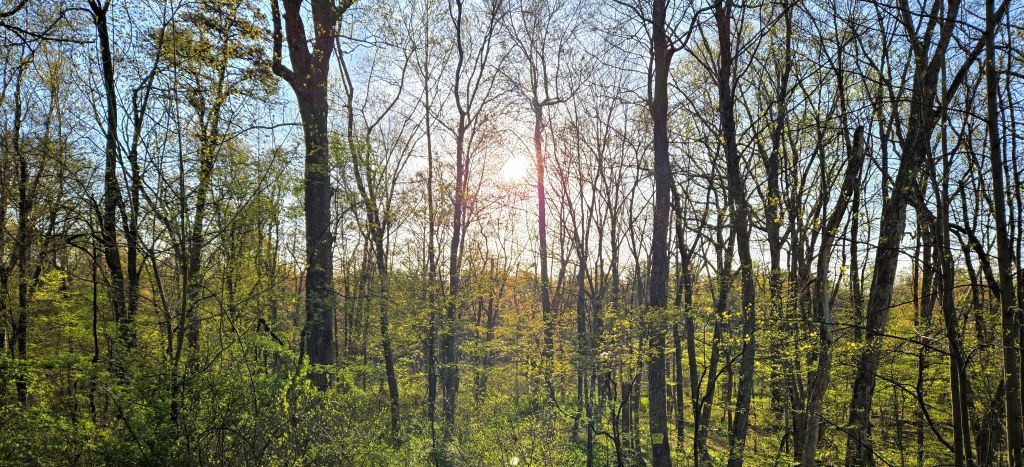
As birds popped up, I took a picture of the sunlight coming through the trees, guessing east, and then did quarter turns taking pics in each direction. I thought the two would make a nice poem of four birds chatting in the morning. I’d use the birds, direction and nature.
The third start was the twelve word conversation I had with the one person I saw in five hours of hiking. I wondered if the twelve words constituted a story, which led me to the six words that brought me back to Hemingway whose short story collection was on my coffee table, but excluded those six words.
From those starts a story was hatched. A twelve word dialogue the center, birds talking before and after. A hiker observing the whole as a narrator who is barely there.
I was missing something, an ending. The narrator had to tell mother that being alone was okay.
Done, or so I thought. The next morning it occurred to me I failed to open with a ‘why’ for the ending. I added a first sentence. Mother warning its dangerous to be alone. Then, I was done.
Every word has at least one purpose and function.
I’ll keep writing short, but now I need to apply the skill of writing tight to longer pieces. What I’ve found is that a core theme has supporting themes and sometimes those do not need as much attention as I give them.
This brings me to something else I read in an interview, write hot, edit cold.
More on that later.
For now, I’ll continue to read the classic short stories, write my own, and attempt to apply the skills required in flash to those of longer pieces. In combination my writing should improve and as it does I’m sure more questions will arise for me to confront and consider. And once I have that all worked out I’ll return to my great American classic.


One response to “Writing journey: Write Tight”
[…] my first post on the writing journey I addressed writing tight, and referenced the genres I […]