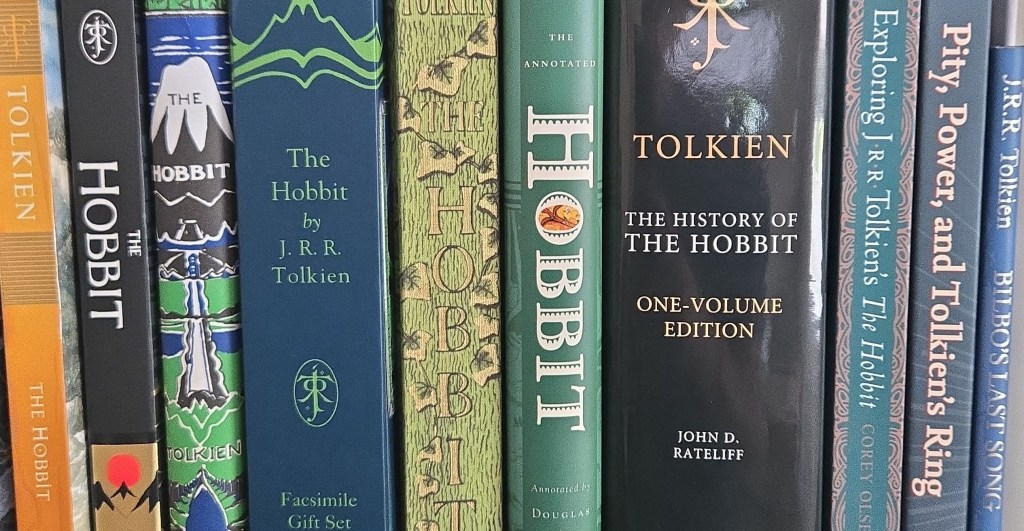
The Hobbit reading concluded with guest presenter John Rateliff, author of the History of the Hobbit. His presentation was pre-recorded in order to serve both scheduled times, and he appeared and participated in person for a Q & A.
He was asked what he learned about Tolkien’s writing process through his research and he noted that he would large chunks of a story and then put it aside. When he returned he’d write another large chunk. In the presentation he addressed his outlines, which were extensive for all his works, but very notational. Most of the outlines would have single words or reminders of items or people to address as opposed to fleshed out ideas. For example a note might be x disappears, but doesn’t say how or why.
When asked about the real climax or end of the Hobbit as there are several it seems in the slaying of Smaug, death of Thorin, return to Bag End, etc., he noted more the significant turn being chapter 5, Riddles in the Dark. At one third of the way in, it wouldn’t be the climax, but he noted in the original it had significantly different meaning than in the revision. The interaction between the two, the compatibility, understanding, adherence to norms and customs, combined with the significance of the Ring in each. One group noted the multiple climaxes made sense from the perspective of the multiple tales being told, that of the Hobbit, the dwarves, and the battle across races.
When asked about the Hobbit as it stands alone versus its entwinement with the Lord of the Rings, Rateliff made a great, easily over-looked point. The Hobbit can never again be read in and of itself. Every reader who reads it today has some knowledge of it even if they hadn’t read it or other works. Even in our discussion group, someone mentioned the power of the ring over Bilbo for his acts that were borderline, his lies, withholding information, and stealing to name a few. Yet in the Hobbit we only knew the ring made one invisible.
He also noted that the narrator was one of his favorite characters across all of Tolkien’s work. This was well-received by host Clair who had declared Tolkien’s belief that the narrator was poorly written in hindsight was a mistake on his part.
The final question was his favorite part, to which he replied Gollum’s line,“thief, thief, thief…we hates it forever.” And he noted it was not a part of the original and arrived in the 1940’s.
My own has always been ‘struck by lightning, struck by lightning’ followed by ‘excitable little fellow’. The entire scene including carrying Bilbo out of the room and setting him aside casually always struck me as being much like life itself.
In the presentation he ended with two points from the outline, the first that Bilbo initially was to have slayed Smaug, which I recalled reading, and the other was to add an explanation of the troll’s keys.
This latter would have been interesting considering the swords found in the cave, what else they may have had access to knowingly or not.
Another good session running about ninety minutes and allowing everyone to share insights and comments across the group and in small sessions. I would have thought there would be a larger turnout, I saw a count of around high thirties about equal to the prior session, given the presenter, but for those of us in attendance, I think I can say it was time well spent.

