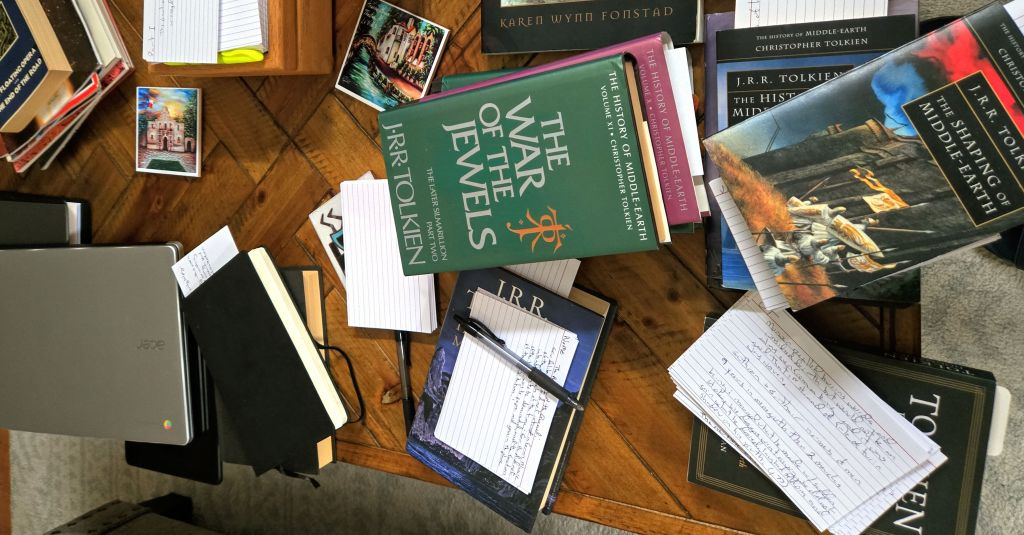
I was waiting for the library to open where we hold the monthly meeting of the Greater Lehigh Valley Writers Group (GLVWG).
While waiting, I first read a post by Pangram’s CEO about how their AI detection tool works based on how LLM’s work, which included an evolutionary explanation of AI, which was helpful. I then read an article by Dr. Sam Illingworth, “You Will be Accused of Using AI. Here is How to Prove You Wrote It.” In this piece one suggeston was to do what I am doing, and I think it is good advice in general.
Interestingly, following the meeting a discussion broke out on AI. Not terribly surprising as it is very controversial in the writing and the arts as it is elsewhere.
My biggest issue on the topic of AI and writing, is what does it mean to say something was written with AI?
For me, when I’m asked about ‘writing’, it is not merely the words you see in the final draft I chose to publish, but the entirety of the process of writing.
In the entirety of the writing process I use AI. I do not use words and sentences crafted by AI. I did experiment to better understand AI by taking some essays and short stories and asking for different levels of feedback.
For instance I’d give the entire piece, then a section, paragraph, and finally a sentence. My personal experience was that AI provided me with better feedback on the macro rather than micro level. When it rewrote for me, it sometimes lost the meaning, it often lost the nuance, and it always stripped my voice and tone.
I’ll address that later.
The reality is that AI has been incorporated into most all of the software we use today and if you use a phone, tablet or computer, you are using AI intentionally or not.
Do I use AI in my writing is the challenging question, because the question is open to interpretation and therefore my answer is as follows.
General
I do not subscribe or pay for AI. I use free versions and accept limitations that come with that choice of mine. I have Gemini and Co-Pilot on both my phone and chromebook for regular usage. I also have Grok, Claude, ChatGTP, and Perplexity on my phone.
There may be others I tried, but these are the ones I use.
If I can set rules and make requests and remember to do so, I request the following. Do not use my history. Do not write for me or provide writing alternatives. And do not refer me to videos for an answer.
Rules fail regularly. I think this is indicative of the bigger AI problem which is that while guardrails and rules are implemented, this is apparently done in a way that there is interpretation as to when the rules apply and the AI has ‘free will’ to break them. Hence rogue agents violating rules.
I do not want my history used because algorithms already encase our individual online world in an echochamber, and I don’t want AI answering to please me based on my history. I am attempting to retrieve objective answers.
This is even more important when my history incorporates chats related to my various interests from fiction to nonfiction to general.
I do not want to be referred to a video to answer a question. A video is a single opinion not an answer. Further, I want to read and not watch TV. If I wanted to watch videos I’d go to a video streaming channel.
Finally, as noted, I found AI was least useful and most disruptive rewriting or making suggestions around my fiction writing. It was better with nonfiction, particularly in clarifying ambiguity. Again, I’ll speak to that more below.
Despite giving a general rule or noting in a chat to give feedback only after a couple answers in its desire to help it will begin rewriting and tell you it is your style and words just arranged a little better.
Just say no. Not so much because it’s ‘wrong’, but because it is stripping your writing of your essence and being. It is sucking your soul from your writing. It is no longer yours because you have been removed, your emotion and feeling, from the words on the page expressing the ideas you started with and AI ended up possessing.
It might read ‘better’ on the surface, but it doesn’t feel quite human. There is something missing that matters. It is felt by the reader.
Fiction
In the process of writing AI is a great tool for several aspects. Each should of course be validated as any resource ought to be. In fiction, many times I simply need to know if something is plausible, I need context, and I want to know if I have followed proper craft structure. Did I leave plot holes or have weird time jumps?
The tools of outlining, summarizing, and reviewing are helpful as well.
Plausibility
There are so many times I want to know if something is plausible enough that a reader won’t stop and say, wait. I think it is fair to ask I’m writing a fiction story, could a person age 38 be a senior agent at the fbi? I’m developing a character and working out details that inform who the character is, and while there are outliers, more often than not they need reliable foundations. While I think it possible, I verify with AI.
I do the same with fact checking my own opinions and recollections. I also get more info to learn background on it. For instance in 1979 US backed government in Iran was overthrown. People loyal to us escaped, came to america, and have lived here. How, what was there status? I asked because I had a character in that situation.
I also use weather, sunrise and sunset charts and Google maps with street view to ensure details are accurate enough to be believablle.
I also ask about names. I had detectives, a cook and other characters in Austin, from texas. I asked for most common texas last names for american boen vs mexican american. I did this for first names and combined as needed for characters. I had a girl group, all early 20s in 2025 so I asked for most common female names born between 2002 and 2005. From those I selected the names.
Validation and suggestion are two main ways I use AI in this regard.
Background & Research
I’ve addressed this a little with jobs, names, locations, etc., and will expand here. I might ask if certain colleges would be reasonable given certain character backgrounds and majors.
Similarly, there was a manifesto referenced and for that I had AI write a manifesto by mashing up existing ones. I used the manifesto’s themes, but did not print the manifesto itself. I wanted a document written by the professor inspired these works and had ai create it for me to reference.
I also had an Iranian character. I received a certificate of concentration in Middle East Studies with my BA, so I have decent knowledge of the region and culture, but much of the detail has not been committed to memory. I used AI to spark recall and dig deeper.
I did the same with technology. I was aware of some technologies and emerging uses, but needed to package and determine which could theoretically work together and do so plausibly, so the tech stack I had my bad guys developing required research and plausibility at a high level not technical detail and AI was good for broad brushstrokes.
Structure and Craft
Here I’ll use a chapter as an example. My chapters are typically 1800 to 3200 words.
I’ll prompt and go from there. I don’t have a hard step by step process. It depends on where I am at with the piece. Often I start with how does this read? I try to gauge what it thinks I’m trying to write. I might tell it I am writing a short story or this is a chapter of a type of story.
Here I’m sensing if what I am trying to do comes across. I could say something more specific, im writing a 2500 short story with the prompt of x how did I do?
I try to remember to include feedback only or it will rewrite parts or in whole.
I also look for issues such as am i telling too much, or I’ll ask it what the themes are to see if they are consistent with what I want.
Like anything, some feedback is good and other feedback is immediately discarded.
For short stories I will often ask to read and respond as a literary editor reviewing it as a submission and as a reader of literary journals, or whatever type you’d consider your work suitable to.
For my novel I have given it chapters and requested a cliffnote styled summary.
I believe these are all helpful for immediate feedback on my work. It is helpful as an organizational tool for me and as a preread in advance of actual beta readers.
Non-Fiction
Often, in my non-fiction, I might forget a source and ask in Tolkiens work where was it written that Blodren betrayed Turin’s company? It is a quick reference. I knew the tale forgot if it was Home 2 or somewhere else. I could look it up, but this is easier.
More often, I use it on subject matter. For instance, I have personal theories on fate and free will, but I might want traditional understandings, or specify specific texts. AI is a good starting point. Once I’ve fleshed out my argument, I will promt for does this hold up? And see where it does and doesn’t. Again, don’t take AI as authoritative, take it as an opinion. Consider it, but don’t simply adopt it.
I might compare regions or people in world or not, and I’ll do the same.
It is also good for outlining the work completed when I’m revising and don’t want to repeat information.
Images
I did create my sigil and logo using AI with prompts. I wanted to incorporate my initials with compass motif and like the way it came out. I use it on my site and business cards. The sigil was for fun, I adopted a latin phrase Hope and Knowledge, Spes et Scienta, based on the two traits I value and threw in some instructions and it generated the hooded sorcerer like figure with the heavens, middle-earth, and maybe hell or purgatorial knot under the triangle.
I also gave character descriptions and generated images of my characters. When I looked and said yes that’s it, I kept the version and referred to it when writing them to find details.
Additional
As noted, it drives me nuts that AI wants to know me in order to answer.
Since I write a lot about Tolkien, my own philosophy, essay, fiction, and a range of personal and quasi professional explorations, I want objective information and answers, not ones catered to my past questions or my resume or my volume of work.
I may be asking to get in a character’s head or from a character’s perspective, not my own.
Having said all that, I have used AI to ask health and wellness questions, purchasing options, and about trends and sensibilities.
For school, I have asked it to mock up an exercise. By that I mean we have a club and I wanted to do a hands on branding exercise. I’ve done corporate rebranding and been a brand champion. I wanted something simple, put in requirements, took the output, modified it and went with it.
I know people who use it to write email or reply and I won’t do this. I also won’t use it to take meeting notes.
I will ask it a lot of questions related to government policy and politics. Again, I often have ideas and want to validate against facts or fact check.
I might want a base or deeper understanding of something and ask.
The critical element in all of these inquiries is that I don’t simply ask a question and accept an answer.
When people ask me the most important thing I learned in college, I reply that I learned how to think.
I use AI as a tool to assist my thinking process and not to replace my thinking.
The same is true of my writing.
More…
Orientation: Return home, or see what I’m currently doing, what I’ve done, and where I might be going.
East (agency): On Writing and Being a Writer.
West (meaning): The Compass & the Current.
North (self): My Evolving Words to Live By.
South (journey): The Nunamaker Group.

